
Do you also feel that buying skincare products is a gamble? Especially if you have a bunch of acne on your face. After that, what do you do? You buy an expensive product, hope that your skin will improve, but the next day, new pimples, blackheads, or whiteheads emerge afresh. The root of this problem is comedogenic ingredients – that is, elements that clog pores.
A pore clogging ingredients checker is a digital tool that eliminates this uncertainty. This article will tell you what these checkers are, why they are necessary, and how you can keep your skin clean by using them.
What is a Pore Clogging Ingredients Checker?
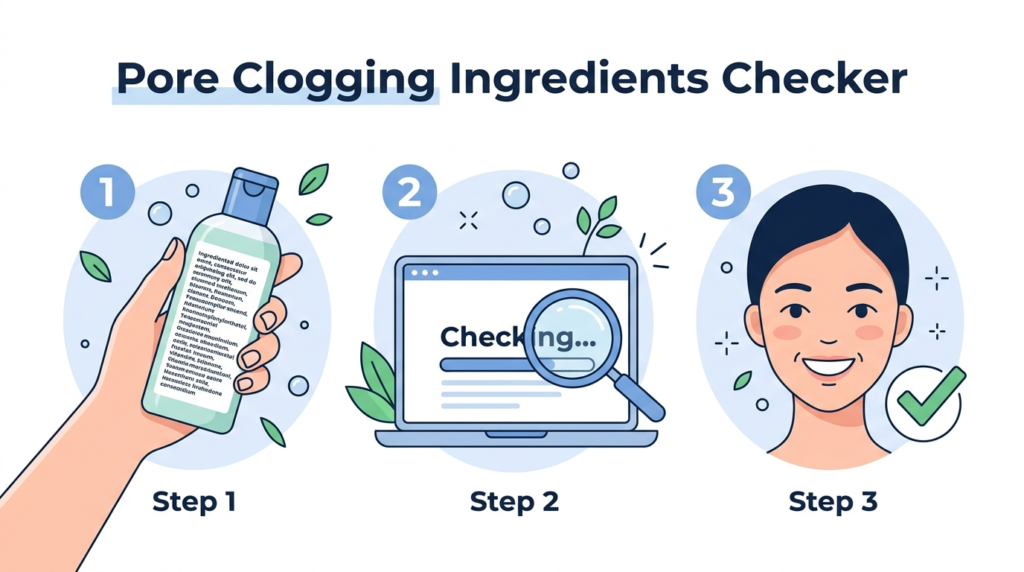
This is a kind of online tool, website, or mobile app. Its job is to scan the ingredient list of any skincare or makeup product and tell whether any element present in it can clog your pores or not. This tool compares your ingredient list with its database, which contains information about thousands of comedogenic substances. Then it gives you a report – whether this product is safe for you or not. Similarly, an ingredients checker is also such a tool, by using which you can properly find out what is good and what is harmful.
Why should you not trust the “Noncomedogenic” label?
You have often seen written on products – “noncomedogenic” or “oil-free”. Does this mean that the product will not clog pores? Not necessarily.
The US Food and Drug Administration (FDA) does not regulate these terms. Any company can print “noncomedogenic” on its product without any strict testing. This means that even products with such labels can contain pore-clogging elements. Therefore, you have to become a detective yourself, and this is where the pore clogging checker comes in handy. This tool saves you from falling for marketing gimmicks. So what are you waiting for? Use our tool now.
How to use a Pore Clogging Checker?
Using these tools is very easy. Just follow these steps:
1. Find the full ingredient list
Look at the product’s packaging or the brand’s website for the INCI (International Nomenclature of Cosmetic Ingredients) list. Copy the entire list.
2. Copy the list
Copy all the ingredients exactly as they are. Some checkers require a format separated by commas (,).
3. Paste in the checker and analyze
Go to your favourite checker tool, paste the list, and press the “Check” or “Analyse” button.
4. See the results
The tool will tell you which ingredients can clog pores. Some tools give a rating from 0 to 5 (5 being the most harmful). Based on this, decide whether to buy the product or not.
Top Pore Clogging Checker Tools in 2025
Here are some excellent tools being given:
https://ingredientschecker.in/ is also a similar tool that is very transparent.
- Acne Clinic NYC: Considered the strictest and most trustworthy in the online acne community. It flags every suspicious ingredient.
- CLEARSTEM Skincare: A modern and user-friendly tool. It balances anti-ageing and acne-safe products.
- Sofie Pavitt Face: Great for mobile users. Very direct – gives a yes or no answer.
- CosDNA: An old and reliable tool. It gives comedogenic ratings of ingredients and user reviews.
- EWG Skin Deep: This is an environmental organisation’s database, which gives safety ratings for thousands of products.
- DermiCheck: This is a Chrome extension. When you shop on sites like Sephora, it highlights pore-clogging ingredients in real time.
Common Pore Clogging Ingredients – Avoid these
Although using a checker is best, it will still be beneficial to know some common enemies:
- Oils and Butters: Coconut Oil, Cocoa Butter, Shea Butter, Wheat Germ Oil.
- Waxes and Esters: Lanolin, isopropyl myristate, and isopropyl palmitate.
- Fatty Alcohols and Acids: Lauric acid and myristic acid.
- Algae and Seaweed: Algae Extract, Carrageenan.
- Others: Some D&C red colors, Sodium Lauryl Sulfate (SLS).
Are these checkers 100% correct? (Limitations)
It is very important to understand that these tools have their limitations. Most comedogenic data is based on studies done on rabbit ears before 2013. Human skin can react differently. But ingredientschecker.in is a recent tool, try using it.
Furthermore, an ingredient that clogs one person’s pores may not be harmful for another. Skin type, pore size, and the concentration of that element in the product also matter. Therefore, use the checker as a guide. Before applying any new product to your entire face, definitely do a patch test on your neck or behind your ear.
Expert tips for acne-prone skin
Just using a checker is not enough. Also, adopt these suggestions:
- Check everything: Not just skincare, but also the list of your makeup, sunscreen, hair products, and even laundry detergent.
- Keep routine simple: A short skincare routine with fewer ingredients is safer. More products mean more risk.
- Know your skin: every skin is different. Keep a diary of which products suit you and which does not.
Conclusion: Take command of your skin
A pore-clogging ingredients checker is your strongest weapon in the fight against acne. It explains complex ingredient lists in simple language, saves you from false marketing claims, and gives you the power to choose the right product. Bookmark one tool today and change your shopping habits. Soon you will find that your skin is becoming clean, healthy, and acne-free.
Hi, this is a comment.
To get started with moderating, editing, and deleting comments, please visit the Comments screen in the dashboard.
Commenter avatars come from Gravatar.