
Are you tired of pimples popping up again and again? You’ve tried creams, face washes, even doctors’ prescriptions – but nothing works for long. The truth is, you might be missing the real problem: the ingredients in your skincare and the ingredients in your food. That’s where an acne ingredients checker comes in.
An acne ingredients checker is a tool (or a simple method) that tells you which ingredients in your lotions, makeup, or even snacks are causing those breakouts. In this article, I’ll show you how to use an acne ingredients checker, which skin-clogging ingredients to avoid, and how an ingredients checker food tool can help you clean up your diet for clearer skin.
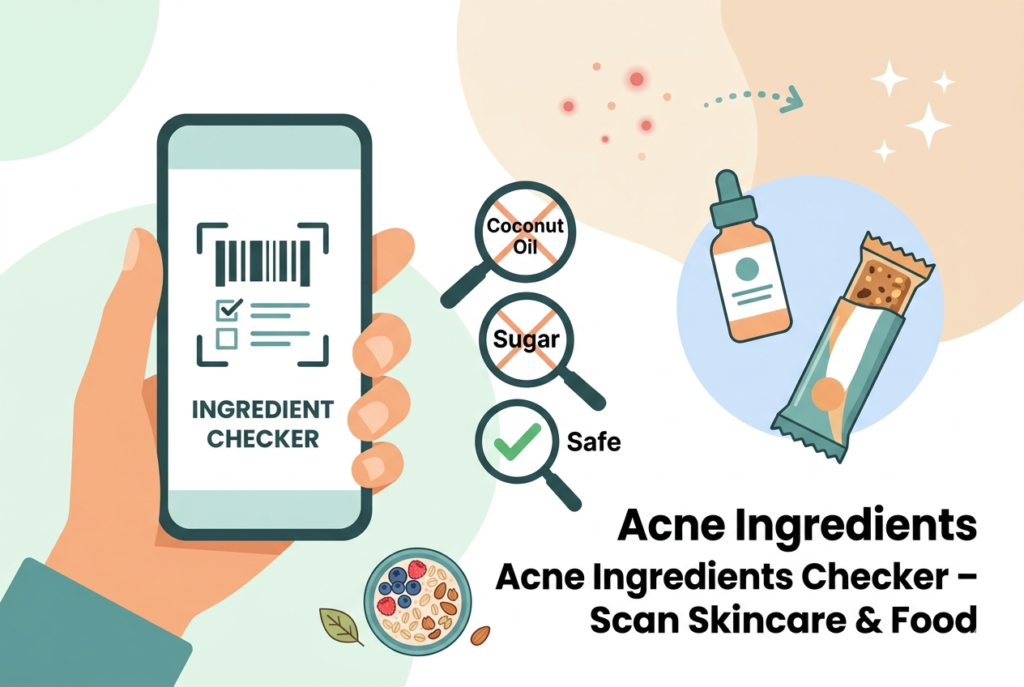
What Is an Acne Ingredients Checker?
An acne ingredients checker is usually an online tool, a mobile app, or a manual process. You take the ingredient list from any product – face cream, sunscreen, foundation, even shampoo – and the checker tells you if any of those ingredients are known to cause acne.
Many people spend a lot of money on expensive moisturizers, not knowing that ingredients like coconut oil, lanolin, or isopropyl myristate are blocking their pores. An acne ingredients checker gives each ingredient a comedogenic rating (from 0 to 5). A rating of 4 or 5 means it’s very likely to clog pores and cause pimples.
But here’s the thing – skincare alone isn’t enough. Today, more and more people are using an ingredients checker for food or a food ingredients checker to see what’s in their packaged foods. Because what you eat shows up on your face. And that’s exactly what we’re going to talk about next.
Bad Ingredients for Acne in Skincare (The Top 5)
Before you even open an app, remember these five common troublemakers. If you see any of these in your product, run them through an acne ingredients checker:
- Cocoa Butter – Very heavy. Rating 4 out of 5 for clogging pores.
- Coconut Oil – Great for hair, terrible for acne-prone skin. Rating 4.
- Lanolin – Comes from sheep’s wool. Found in many lip balms and heavy creams. Very pore-clogging.
- Isopropyl Myristate – A synthetic oil that goes deep into pores and causes redness and pimples.
- Alcohol (Denatured) – Dries out your skin, which makes your skin produce even more oil. More oil = more acne.
A good acne ingredients checker (like INCIdecoder, CosDNA, or AcneClinicNYC’s tool) will spot these for you. Just copy and paste the ingredient list.
Can Food Ingredients Really Cause Acne? Yes!
Now let’s talk about the ingredients checker food side. You might be using the perfect skincare routine, but if you’re eating foods that trigger acne, your face will never fully clear up.
I recommend using a food ingredients checker or food ingredient checker on any packaged food you buy. Look for these five troublemakers:
- High Fructose Corn Syrup (HFCS) – This spikes your insulin, which makes your oil glands go into overdrive.
- Refined Sugar – White sugar, brown sugar, cane sugar – all cause inflammation in your body, which leads to pimples.
- Trans Fats (Partially Hydrogenated Oils) – These mess up your hormones and make acne worse.
- Dairy Solids or Whey Protein – Found in protein bars, protein powders, and many chips. They increase a hormone called IGF-1, which tells your skin to make more oil.
- Artificial Colors and Flavors – Some people are sensitive to these, leading to skin inflammation.
A good food ingredient analyzer can help you scan a product’s barcode and tell you immediately if it’s safe for acne-prone skin.
Don’t Forget the Toxic Ingredients Checker
There’s another layer to this: toxic chemicals. Many skincare and food products contain ingredients that aren’t just bad for acne – they’re bad for your whole body. That’s why a toxic ingredients checker is so useful.
The good news is you can find a toxic ingredients checker free of cost. Apps like Yuka, Think Dirty, or EWG’s Skin Deep let you scan a barcode and see a safety rating.
What does a toxic ingredients checker look for?
- Parabens – Hormone disruptors. Can cause hormonal acne.
- Phthalates – Often hidden under “fragrance”. Linked to hormonal imbalances.
- Sodium Lauryl Sulfate (SLS) – Strips your skin’s natural barrier, making it easier for bacteria to cause pimples.
- Artificial Sweeteners (like Aspartame) – Bad for gut health. An unhealthy gut often shows up as acne on your face.
Using a toxic ingredients checker free app takes just a few seconds. Scan your face wash, your protein bar, your soda – you’ll be surprised at what you find.
What Is a Healthy Food Ingredient Checker?
You’ve probably seen snacks labeled “healthy,” “natural,” or “low-fat.” But many of those are full of sugar and chemicals. A healthy food ingredient checker helps you see through the marketing.
Here’s how you can be your own healthy food ingredient checker:
- Look for a short ingredient list (5-7 items max).
- Make sure the first ingredient is a whole food (like oats, nuts, or fruit) – not sugar or oil.
- Check that there’s no high fructose corn syrup.
- Look for at least 3 grams of fiber per serving.
- Avoid anything with partially hydrogenated oil (trans fat).
If you use a food product ingredient checker like Yuka or Open Food Facts, they’ll do all this for you automatically. Just scan and read the score.
Best Acne Ingredients Checker Tools (Skincare + Food)
You don’t need to be a scientist. Here are the easiest tools that work as an acne ingredients checker and an ingredients checker for food at the same time:
| Tool Name | Type | What It Checks | Free? |
|---|---|---|---|
| Yuka | Mobile App | Food + Cosmetics (scan barcode) | Free |
| CosDNA | Website | Skincare ingredients (comedogenic rating) | Free |
| INCIdecoder | Website | Skincare (pore-clogging ratings) | Free |
| EWG’s Food Scores | Web/App | Food ingredients (safety + nutrition) | Free |
| Think Dirty | App | Skincare + some food (toxic ingredients checker free) | Free |
With these, you can stand in the grocery store aisle or in front of your bathroom mirror and quickly check any product.
How to Read Any Ingredient List Like a Pro
Let me make this really simple. You don’t always need an app – you can train your eyes.
For skincare (acne ingredients checker method):
- Look at the first 5 ingredients. Those make up most of the product.
- If you see any oil (coconut, palm, olive) or ester (anything with “isopropyl” or “myristate”) in the top 5, be careful.
- Also avoid “lanolin,” “algae extract,” and “carrageenan” – they can clog pores.
For food (food ingredients checker method):
- Look for words ending in “ose” – those are sugars (sucrose, fructose, dextrose).
- Look for “hydrogenated” or “partially hydrogenated” – that’s bad trans fat.
- Look for long chemical names you can’t pronounce – that usually means artificial additives.
- Shorter list = usually better for your skin.
You can use any food ingredient analyzer app to confirm, but these rules work 90% of the time.
Common Mistakes People Make
Even when people start using an acne ingredients checker, they mess up in a few ways. Don’t be like them.
Mistake #1: Only checking skincare, never checking food.
- Fix: Use an ingredients checker food on everything you eat for one week. You’ll likely find your real acne trigger.
Mistake #2: Trusting “non-comedogenic” labels.
- Fix: That word is not regulated. Any company can slap it on a product. Always use a real acne ingredients checker.
Mistake #3: Thinking “natural” means safe for acne.
- Fix: Coconut oil is natural. It’s also highly pore-clogging. Natural does not equal good for acne.
Mistake #4: Using only one tool.
- Fix: Different tools have different databases. Use Yuka for food, CosDNA for skincare ingredients, and EWG for toxic chemicals.
Mistake #5: Ignoring your own experience.
- Fix: If a product passes the toxic ingredients checker free app but still breaks you out – trust your skin. You might be sensitive to a “safe” ingredient.
Final Thoughts – Start Using an Acne Ingredients Checker Today
If you’re serious about getting rid of acne, you have to check both your skincare and your food. An acne ingredients checker is not a luxury – it’s a necessity in today’s world of long ingredient lists and tricky marketing.
Whether you use an ingredients checker food, a toxic ingredients checker free app, or a healthy food ingredient checker – the goal is the same: to help you make better choices for your skin and body.
So here’s your action plan for today:
- Pick one skincare product from your bathroom.
- Pick one packaged snack from your kitchen.
- Use any food product ingredient checker or acne ingredients checker (Yuka or CosDNA are great).
- Look for pore-clogging ingredients and acne-triggering food additives.
- Replace the worst ones with cleaner options.
Do this for two weeks, and I promise you’ll see a difference. Clear skin starts with knowing what you’re putting on your face and in your body. Now go check those labels!
Frequently Asked Questions
Q: Can one app work as both an acne ingredients checker and a food ingredients checker?
A: Yes. Yuka is the best all-in-one. Scan any barcode – it tells you the risk for acne and overall safety.
Q: Are free toxic ingredients checkers reliable?
A: Mostly yes. EWG’s Skin Deep and Think Dirty (free versions) are trustworthy. They might miss a few new products, but for 90% of items, they’re accurate.
Q: Should I trust products labeled “non-comedogenic”?
A: No. It’s not a regulated term. Always run the ingredient list through an acne ingredients checker yourself.
Q: How do I use a food ingredient analyzer at home for fresh foods?
A: For fresh foods like fruits, veggies, and meat – no app needed. Just eat single-ingredient whole foods. For packaged foods, scan the barcode with Yuka or Open Food Facts.
Q: What’s the single worst ingredient for acne in food?
A: Sugar (all forms). It causes inflammation and oil production. Cut down sugar and watch your skin improve.